Intel Alder Lake 12th generation processors, including the Core i9-12900K, went on sale in November 2021, bringing new enthusiasm to the x86 processor segment. Taking its cue from the ARM big.LITTLE heterogeneous computing architecture, which has proven its utility in smartphones and tablets for more than 5 years, the Core i9-12900K chips also host 8 Performance or high-performance cores, in addition to 8 Efficient power-efficient cores. This combination allows the processor to run more efficiently, as the P-core is responsible for the highest performance on complex tasks, while the E-core handles background processes in the operating system and ensures low power consumption during web browsing and other less demanding activities.
YouTube
By displaying this content, YouTube sets its cookies, so we only show it with your consent. The button accepts all cookies - statistics and marketing - throughout the site; You can change your choice at any time.
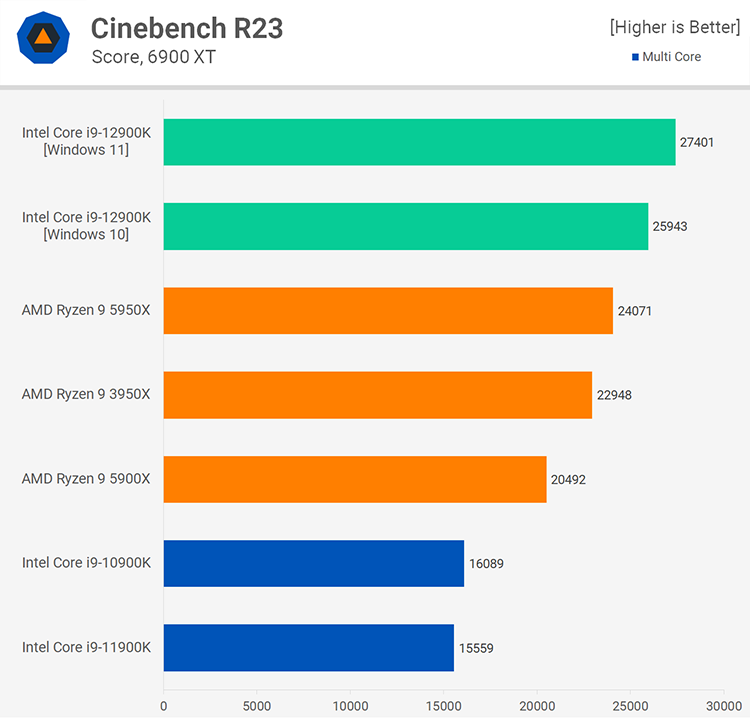
With 30 MB cache, 8 P and 8 E cores, the Core i9-12900K not only beats the previous generation flagship Core i9-11900K by 76% in the CineBench R23 multi-core test, but also defeats all AMD Ryzen 5000 series processors, including the 16-core Ryzen 9 5950X.
With the amazingly powerful Alder Lake cores, Core i9-12900K proves itself in the latest PC games. We chose Far Cry: New Dawn as an example because it uses the well-known Dunia 2 Engine, which also powers the latest game in the franchise, Far Cry 6. Dunia 2 has particularly high demands on CPU power.
It's the 12th generation Core i9-12900K processor that delivers the highest FPS with the powerful GeForce RTX 3090 graphics card, outperforming all Intel 11th generation and AMD Ryzen 5000 series models.
Core i9-12900K photo processing
Thanks to its new architecture, Core i9-12900K has regained its leading position in Adobe's most popular photo processing applications, Photoshop and Lightroom. Intel's most powerful Alder Lake model has a 5-15% advantage over the Ryzen 9 5950X, depending on whether DDR4 or DDR5 RAM is used.
Core i9-12900K in video processing
A 15% performance gain in photo processing tasks is impressive, but what about the fact that Core i9-12900K outperforms the more powerful AMD 16-core Ryzen 9 5950X by more than 30% in Adobe Premiere Pro video processing? Impressive!
Core i9-12900K power consumption and cooling
You may have heard the saying "with great power comes great responsibility". In the Intel Core i9-12900K situation, we can rephrase it a little differently - "with great power comes great power consumption and increased heat output". According to the specification, the TDP of this model is 125W, which denotes the consumption when all cores are running at their base frequency 3.20 GHz. When the processor is subjected to highly complex operations, its P cores increase their frequency to 5.20 GHz, which can result in an actual consumption of up to 228W.
According to TechSpot, the Core i9-12900K system can consume 120-140W more power under heavy load than the most powerful AMD Ryzen processors. These figures do not take into account the performance of the video card, so it's easy to exceed the 700W limit when paired with one of the more powerful NVIDIA GeForce or AMD Radeon video cards. This should be taken into account when choosing a power supply, so for a Core i9-12900K based PC we recommend choosing a PSU of at least 850W or more.
To keep the heat in check, we recommend that any system with a 12th generation Core i9-12900K processor is equipped with a 360mm or 420mm water cooler and a high volume case with multiple intake and exhaust fans to ensure the fastest and most efficient air exchange.
This parameter determines the CPU socket on the mother board for which the particular CPU is intended. Physically the CPU can be placed in the compliant socket only. Prior to buying the CPU you should verify that your motherboard has the corresponding CPU socket.
The CPU type indicates the CPU models set by the manufacturer based upon their capacity and the application features. For Intel CPUs these are starting from most powerful - Core i7, Core i5, Core i3, Core 2 Quad, Core 2 Duo, Pentium Dual Core and Celeron models.
The CPU manufacturer Intel has introduced the system of numbering of CPUs that allows accurate identification of each CPU manufactured by Intel and its compatibility with motherboards. Prior to buying the CPU you verify the support of this CPU number on the website of the motherboard manufacturer.
The number of the CPU cores is the parameter of the operation speed and stability. CPU with two or more cores can handle tasks in parallel, thus achieving extra high-speed and the system stability. Prior to buying a multi-core CPU you should verify if the motherboard supports this type of CPU.
The CPU clock frequency is the index of operation speed that determines the number of calculation cycles that the CPU can perform per second. Higher clock frequency means higher operation speed.
Small, fast memory that stores the copies of the data memories from the main memory that are most often used by the computer applications. It is like a temporary storage or data buffer between the CPU and RAM.
It shows with how big numbers it can operate within a single cycle. It is advisable to have this index at the level of 512 KB or at least 256 KB.
Category1 - CPU
Category 1 - CPUs
Category 2 - Intel CPUs
Description1 - Intel Core i9-12900K - 16x - 3.2 GHz - LGA1700 Socket - Tray
Description2 - Intel® Trusted Execution TechnologyIntel® Trusted Execution Technology for safer computing is a versatile set of hardware extensions to Intel® processors and chipsets that enhance the digital office platform with security capabilities such as measured launch and protected execution. It enables an environment where applications can run within their own space, protected from all other software on the system.Intel® Virtualization Technology for Directed I/O (VT-d)Intel® Virtualization Technology for Directed I/O (VT-d) continues from the existing support for IA-32 (VT-x) and Itanium® processor (VT-i) virtualization adding new support for I/O-device virtualization. Intel VT-d can help end users improve security and reliability of the systems and also improve performance of I/O devices in virtualized environments.Intel® Virtualization Technology (VT-x)Intel® Virtualization Technology (VT-x) allows one hardware platform to function as multiple “virtual” platforms. It offers improved manageability by limiting downtime and maintaining productivity by isolating computing activities into separate partitions.Intel® 64Intel® 64 architecture delivers 64-bit computing on server, workstation, desktop and mobile platforms when combined with supporting software.¹ Intel 64 architecture improves performance by allowing systems to address more than 4 GB of both virtual and physical memory.Intel® Clear Video HD TechnologyIntel® Clear Video HD Technology, like its predecessor, Intel® Clear Video Technology, is a suite of image decode and processing technologies built into the integrated processor graphics that improve video playback, delivering cleaner, sharper images, more natural, accurate, and vivid colors, and a clear and stable video picture. Intel® Clear Video HD Technology adds video quality enhancements for richer color and more realistic skin tones.CacheCPU Cache is an area of fast memory located on the processor. Intel® Smart Cache refers to the architecture that allows all cores to dynamically share access to the last level cache.Intel® AES New InstructionsIntel® AES New Instructions (Intel® AES-NI) are a set of instructions that enable fast and secure data encryption and decryption. AES-NI are valuable for a wide range of cryptographic applications, for example: applications that perform bulk encryption/decryption, authentication, random number generation, and authenticated encryption.Idle StatesIdle States (C-states) are used to save power when the processor is idle. C0 is the operational state, meaning that the CPU is doing useful work. C1 is the first idle state, C2 the second, and so on, where more power saving actions are taken for numerically higher C-states.Intel® Turbo Boost TechnologyIntel® Turbo Boost Technology dynamically increases the processor's frequency as needed by taking advantage of thermal and power headroom to give you a burst of speed when you need it, and increased energy efficiency when you don’t.Max Turbo FrequencyMax Turbo Frequency is the maximum single-core frequency at which the processor is capable of operating using Intel® Turbo Boost Technology and, if present, Intel® Turbo Boost Max Technology 3.0 and Intel® Thermal Velocity Boost. Frequency is typically measured in gigahertz (GHz), or billion cycles per second.Execute Disable BitExecute Disable Bit is a hardware-based security feature that can reduce exposure to viruses and malicious-code attacks and prevent harmful software from executing and propagating on the server or network.Intel® Hyper-Threading TechnologyIntel® Hyper-Threading Technology (Intel® HT Technology) delivers two processing threads per physical core. Highly threaded applications can get more work done in parallel, completing tasks sooner.Instruction SetAn instruction set refers to the basic set of commands and instructions that a microprocessor understands and can carry out. The value shown represents which Intel’s instruction set this processor is compatible with.Intel® Quick Sync VideoIntel® Quick Sync Video delivers fast conversion of video for portable media players, online sharing, and video editing and authoring.Intel vPro® Platform EligibilityThe Intel vPro® platform is a set of hardware and technologies used to build business computing endpoints with premium performance, built-in security, modern manageability and platform stability.Intel® VT-x with Extended Page Tables (EPT)Intel® VT-x with Extended Page Tables (EPT), also known as Second Level Address Translation (SLAT), provides acceleration for memory intensive virtualized applications. Extended Page Tables in Intel® Virtualization Technology platforms reduces the memory and power overhead costs and increases battery life through hardware optimization of page table management.Intel® Optane™ Memory SupportedIntel® Optane™ memory is a revolutionary new class of non-volatile memory that sits in between system memory and storage to accelerate system performance and responsiveness. When combined with the Intel® Rapid Storage Technology Driver, it seamlessly manages multiple tiers of storage while presenting one virtual drive to the OS, ensuring that data frequently used resides on the fastest tier of storage. Intel® Optane™ memory requires specific hardware and software configuration.Enhanced Intel SpeedStep® TechnologyEnhanced Intel SpeedStep® Technology is an advanced means of enabling high performance while meeting the power-conservation needs of mobile systems. Conventional Intel SpeedStep® Technology switches both voltage and frequency in tandem between high and low levels in response to processor load. Enhanced Intel SpeedStep® Technology builds upon that architecture using design strategies such as Separation between Voltage and Frequency Changes, and Clock Partitioning and Recovery.Intel® Secure KeyIntel® Secure Key includes instructions RDRAND and RDSEED and the underlying the hardware implementation used to generate high-quality keys for cryptographic protocols.Intel® Speed Shift TechnologyIntel® Speed Shift Technology uses hardware-controlled P-states to deliver dramatically quicker responsiveness with single-threaded, transient (short duration) workloads, such as web browsing, by allowing the processor to more quickly select its best operating frequency and voltage for optimal performance and power efficiency.Intel® Deep Learning Boost (Intel® DL Boost) on CPUA new set of embedded processor technologies designed to accelerate AI deep learning use cases. It extends Intel AVX-512 with a new Vector Neural Network Instruction (VNNI) that significantly increases deep learning inference performance over previous generations.Instruction Set ExtensionsInstruction Set Extensions are additional instructions which can increase performance when the same operations are performed on multiple data objects. These can include SSE (Streaming SIMD Extensions) and AVX (Advanced Vector Extensions).Intel® Turbo Boost Max Technology 3.0 FrequencyIntel® Turbo Boost Max Technology 3.0 identifies the best performing core(s) on a processor and provides increased performance on those cores through increasing frequency as needed by taking advantage of power and thermal headroom. Intel® Turbo Boost Max Technology 3.0 frequency is the clock frequency of the CPU when running in this mode.Intel® Turbo Boost Max Technology 3.0Intel® Turbo Boost Max Technology 3.0 identifies the best performing core(s) on a processor and provides increased performance on those cores through increasing frequency as needed by taking advantage of power and thermal headroom.Intel® Total Memory EncryptionTME – Total Memory Encryption (TME) helps protect data against exposure via physical attack on memory, such as cold-boot attacks.Thermal Monitoring TechnologiesThermal Monitoring Technologies protect the processor package and the system from thermal failure through several thermal management features. An on-die Digital Thermal Sensor (DTS) detects the core's temperature, and the thermal management features reduce package power consumption and thereby temperature when required in order to remain within normal operating limits.Intel® Volume Management Device (VMD)Intel® Volume Management Device (VMD) provides a common, robust method of hot plug and LED management for NVMe-based solid state drives.Intel® Gaussian & Neural AcceleratorIntel® Gaussian & Neural Accelerator (GNA) is an ultra-low power accelerator block designed to run audio and speech-centric AI workloads. Intel® GNA is designed to run audio based neural networks at ultra-low power, while simultaneously relieving the CPU of this workload.Mode-based Execute Control (MBEC)Mode-based Execute Control can more reliably verify and enforce the integrity of kernel level code.Intel® Stable IT Platform Program (SIPP)The Intel® Stable IT Platform Program (Intel® SIPP) aims for zero changes to key platform components and drivers for at least 15 months or until the next generational release, reducing complexity for IT to effectively manage their computing endpoints.Intel® Boot GuardIntel® Device Protection Technology with Boot Guard helps protect the system’s pre-OS environment from viruses and malicious software attacks.Intel® Control-Flow Enforcement TechnologyCET - Intel Control-flow Enforcement Technology (CET) helps protect against the misuse of legitimate code snippets through return-oriented programming (ROP) control-flow hijacking attacks.
EAN - 8592978343187
Manufacturer - Intel
ManufacturerID - CM8071504549230
MPN - CM8071504549230
Name - Intel S1700 CORE i9 12900K TRAY 16x3.2 125W GEN12
PackageHeight - 10
PackageLength - 45
PackageWeight - 40
PackageWidth - 40
WEEE - DE63917628
Weight - 0.035
We use cookies. Necessary cookies ensure the operation of the site - shopping cart, login and language selection. Statistics and marketing cookies are only used with your consent. Some partners (Google, Meta, Microsoft) process data in the USA. You can change or withdraw your choice at any time, using the link at the bottom of the page. More about cookies